
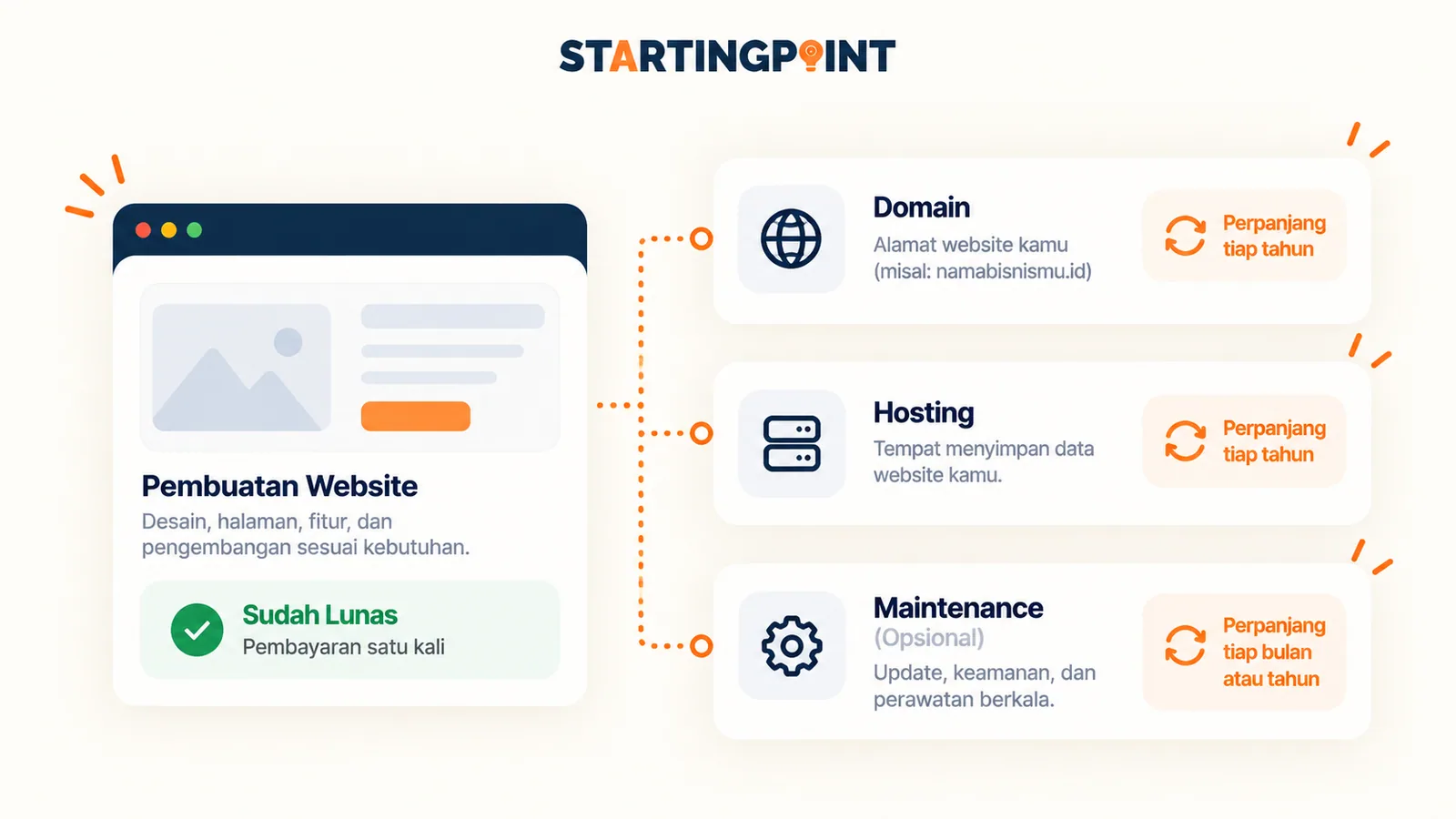
“If a website is a one-time payment, why does the domain still need renewing?” It's a fair question, because the word website is often used to describe several components that are actually different.
The simplest way to understand it is to separate the address, the place where the website runs, and the website's content. All three are connected, but ownership and payment structures can differ.
Domain: the address visitors type
A domain is an address name like `yourbusiness.id`. When customers type that address, the domain system helps point them to the service where the website runs. Domains are registered through a registrar and usually have a fixed term. That's why there's a recurring renewal fee.
What you need to check isn't just the first-year price. Ask about the renewal price, who holds the registrar account, which administrative contact is used, and what happens if you change developers one day.
Recommended practice: register the domain using an account or business identity you control. If a vendor helps with the purchase, ask for documentation on who holds management rights and how access works.
Hosting provides the resources that let a website be reached over the internet. For a simple website, the infrastructure might be a managed hosting service. For an online store, it can include a database, image storage, transactional email services, and backup facilities.
Hosting or infrastructure: where the website runs
Hosting costs don't always show up as a separate line on the invoice. Some providers bundle them into a maintenance package, some bill separately, and some offer different models based on capacity. That's why “no monthly fee” should be read together with the details of the support and infrastructure included.
Website: the design, content, and functionality that get built
The website is the digital product visitors see and use: pages, navigation, catalogs, forms, and ordering systems. The cost of building it is often a project fee—for design, development, testing, and launch.
A one-time development fee doesn't automatically mean all supporting services are free forever. Domains, technical updates, backups, storage, and third-party features can each have their own cost structure.
Cost components that often get mixed up
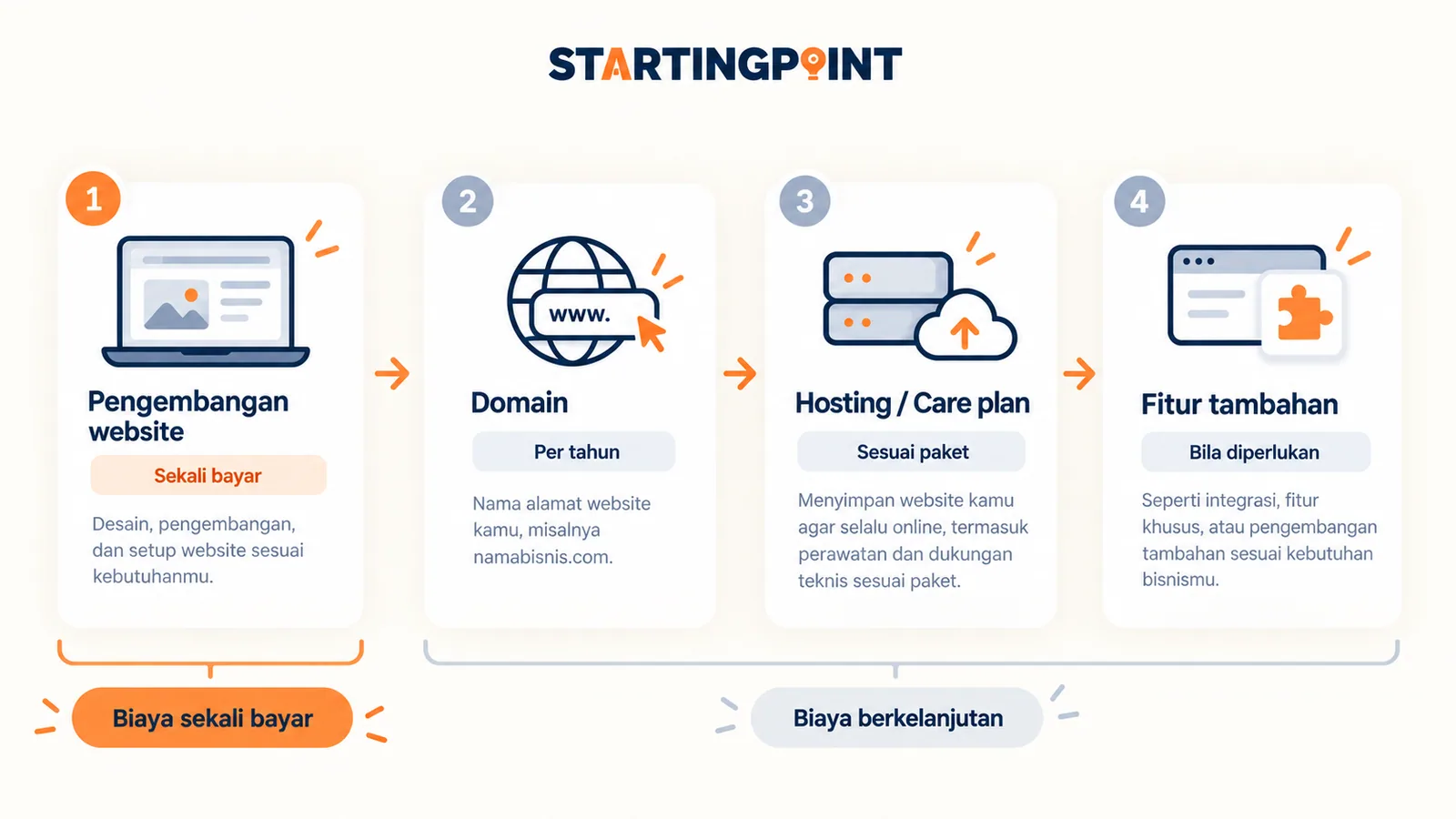
| Component | What is it for? | Questions before buying |
|---|---|---|
| Website development | Building the design and functionality | Which features and revisions are included? |
| Domain | The website's address | Who manages it, and what's the renewal cost? |
| Hosting/infrastructure | Running the website | What capacity and support are included? |
| Maintenance | Handling issues and updates | Is there an SLA, backups, and data recovery? |
| Additional services | Email, payment gateway, APIs, and similar | Are there transaction or third-party fees? |
This table is a framework for checking, not a claim that every website must buy each component separately.
What does “owning your website” actually mean?
Ownership isn't just about being able to open the admin page. There are several layers to clarify from the start: domain access, rights to use the design, access to content and data, rights to the source code, licenses for images or components, and the migration process if the partnership ends.
Not every service grants the same rights to every component. For example, a client may own the content and domain, while some technologies use third-party licenses. Ask for written terms on deliverables and usage rights rather than relying on a “full ownership” claim that hasn't been spelled out.
Checklist before paying for a project
- Make sure the domain is registered under a clearly identified identity.
- Ask for an explanation of upfront and recurring costs, along with their payment dates.
- Check who holds admin access and how recovery works.
- Ask whether and how data can be exported.
- Review the backup, recovery, and post-launch support procedures.
- Keep the agreement on features, revisions, warranty, and change requests in a written document.
For example, Startingpoint explains that development costs depend on the package, while domains are purchased separately and some packages carry recurring service fees. Always check the current details on the Startingpoint page before making a purchase.
To compare vendor proposals, continue to one-time payment vs. subscription websites and a guide to calculating three years of website costs.
Conclusion
Domain, hosting, and website are not three names for the same thing. Treat them separately when you calculate costs and review access rights. A low upfront price is only truly attractive if the responsibilities after launch are also clear.