
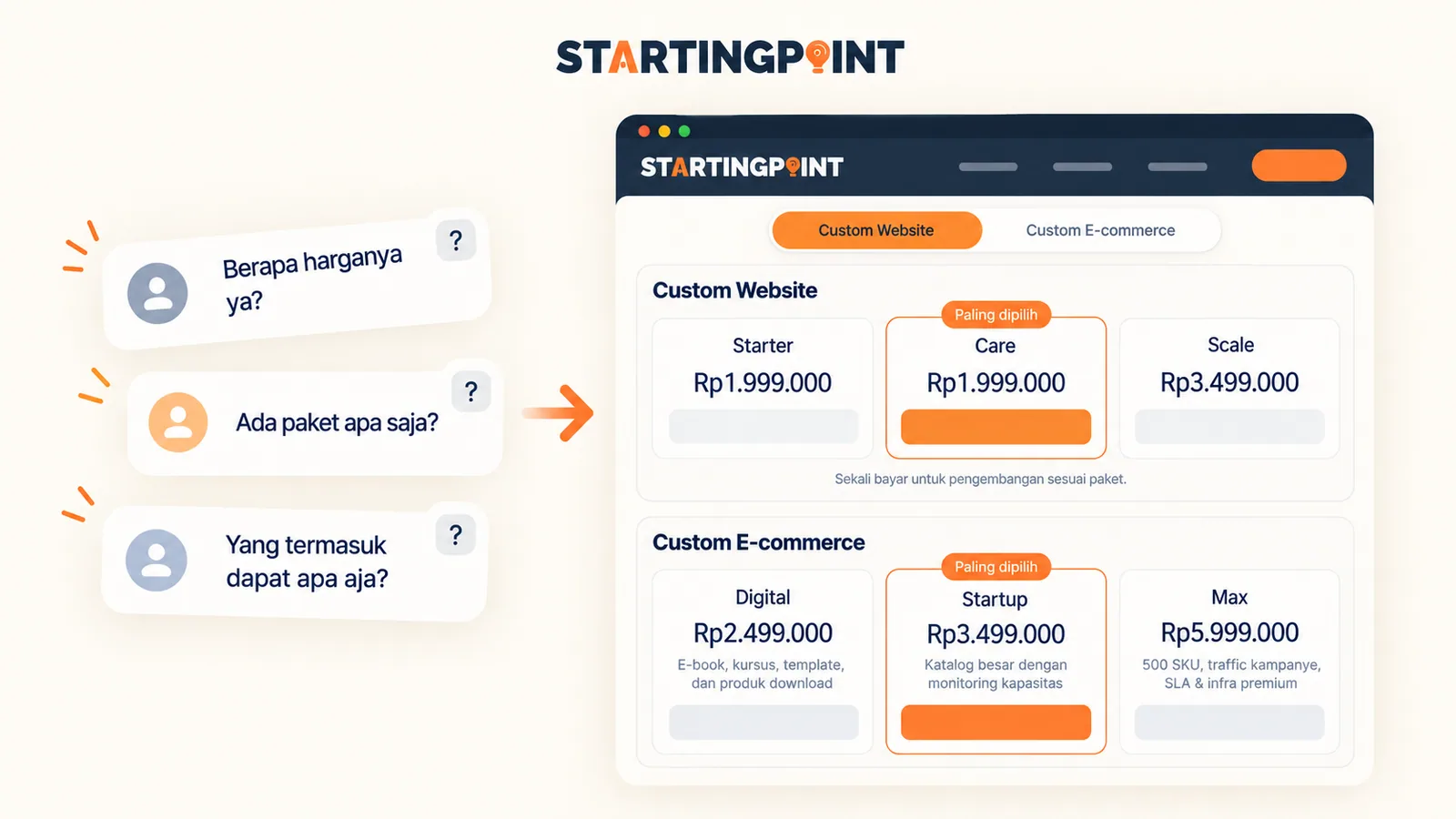
Many business owners ask “how much does a website cost?” as if every website were the same product. In reality, a website with a company profile and a WhatsApp button is a different job from an online store that handles stock, orders, and payments.
To compare proposals, separate upfront costs, recurring costs, and the cost of adding features later. That way, a figure that looks cheap in the first month won't surprise you a year from now.
1. Define your needs before asking for a price
Write down your primary goal first. A company profile website usually needs service pages, a portfolio, contact details, and business information. A campaign landing page emphasizes a single offer and a call-to-action button. An online store may need a catalog, product variations, a cart, checkout, and order management.
Page count alone doesn't determine cost. Payment integrations, stock synchronization, custom dashboards, multiple admin roles, or data migration can add development time. Ask your vendor to separate the features required at launch from those that can be added later.
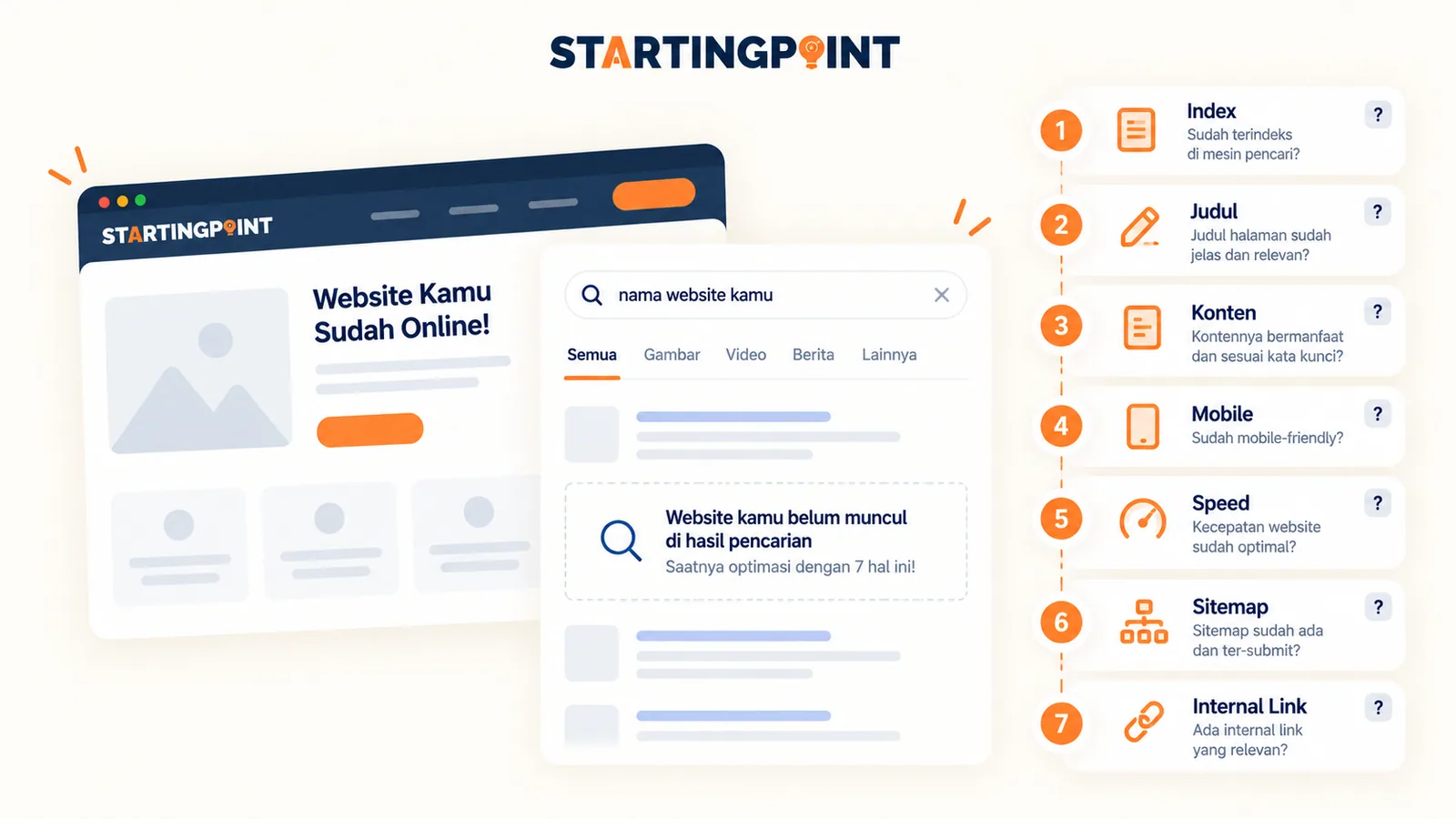
2. Break costs into four groups
| Group | Example | Type |
|---|---|---|
| Development | Design, coding, testing | Usually a project fee |
| Domain | Domain name registration | Usually recurring |
| Infrastructure and support | Hosting, backups, monitoring, maintenance | Depends on the package |
| Growth | New content, new features, integrations, campaigns | As needed |
Don't assume every item above is always billed separately. Ask which ones are already included in the package and which need to be budgeted on top of it.
3. A sample simulation using prices shown on Startingpoint
Startingpoint lists starting prices for custom websites: Starter at Rp1.999.000, Care at Rp1.999.000, and Scale at Rp3.499.000. The domain is listed separately, starting at Rp250.000 per year. The Starter package lists no monthly fee, while Care shows Rp100.000/month or Rp1.000.000/year when paid annually, and Scale shows Rp250.000/month or Rp2.500.000/year when paid annually.
Here is a sample three-year calculation, assuming prices stay the same, the domain uses the starting price listed, and annual service payments are chosen where available. This is not a guarantee of future rates and does not include add-on features or third-party costs.
| 3-year component | Starter | Care |
|---|---|---|
| Initial development | Rp1.999.000 | Rp1.999.000 |
| Domain: Rp250.000 × 3 | Rp750.000 | Rp750.000 |
| Recurring services | Rp0 per the package table | Rp3.000.000 (Rp1 million × 3) |
| Illustrative subtotal | Rp2.749.000 | Rp5.749.000 |
That difference doesn't mean Care is “more expensive with no benefit.” The service page lists daily backups and data recovery for Care, which are not included in Starter. Review your risk and maintenance needs before comparing the subtotals.
Important note: a domain cost “starting at” means the actual price may differ. Also confirm the infrastructure terms, service period, applicable taxes, and optional fees in the latest official quote.
4. What budget if you don't know your website traffic yet?
For a first website, avoid buying capacity based on traffic numbers you haven't proven yet. Start from realistic needs: how many products, how many admins, how often content changes, and whether there are transactions. If you plan to run large ad campaigns or sell thousands of SKUs, share those projections when you request a quote.
Technical capacity listed in a package should also be read alongside fair-use terms and the infrastructure design. “Unlimited” claims are best clarified in writing so both sides share the same expectations.
5. Don't forget the cost of running things after launch
Some costs don't always appear on the developer's invoice: photographing products, writing descriptions, setting up a process for receiving orders, checking incoming chats, and updating prices. A website that is finished but not maintained on the content side will struggle to deliver value.
Decide who on your team will own that work. One accountable content person is often more important than adding features you won't use yet.
6. A quote request format that makes prices easy to compare
Send a brief covering: target customers, the three main actions you want visitors to take, the number of pages or products, must-have features, reference examples, integrations, deadlines, and post-launch needs. Ask for a response that separates upfront costs, recurring costs, third-party costs, revision limits, warranty, and work outside the scope.
Use the business website brief template and read the comparison of one-time payment vs subscription models.
Conclusion
A good website budget isn't just the price of building pages. Factor in the domain address, operations, maintenance, and your team's capacity to fill in content. For current pricing and scope, see Startingpoint's packages and ask for an estimate based on your business's real needs.