
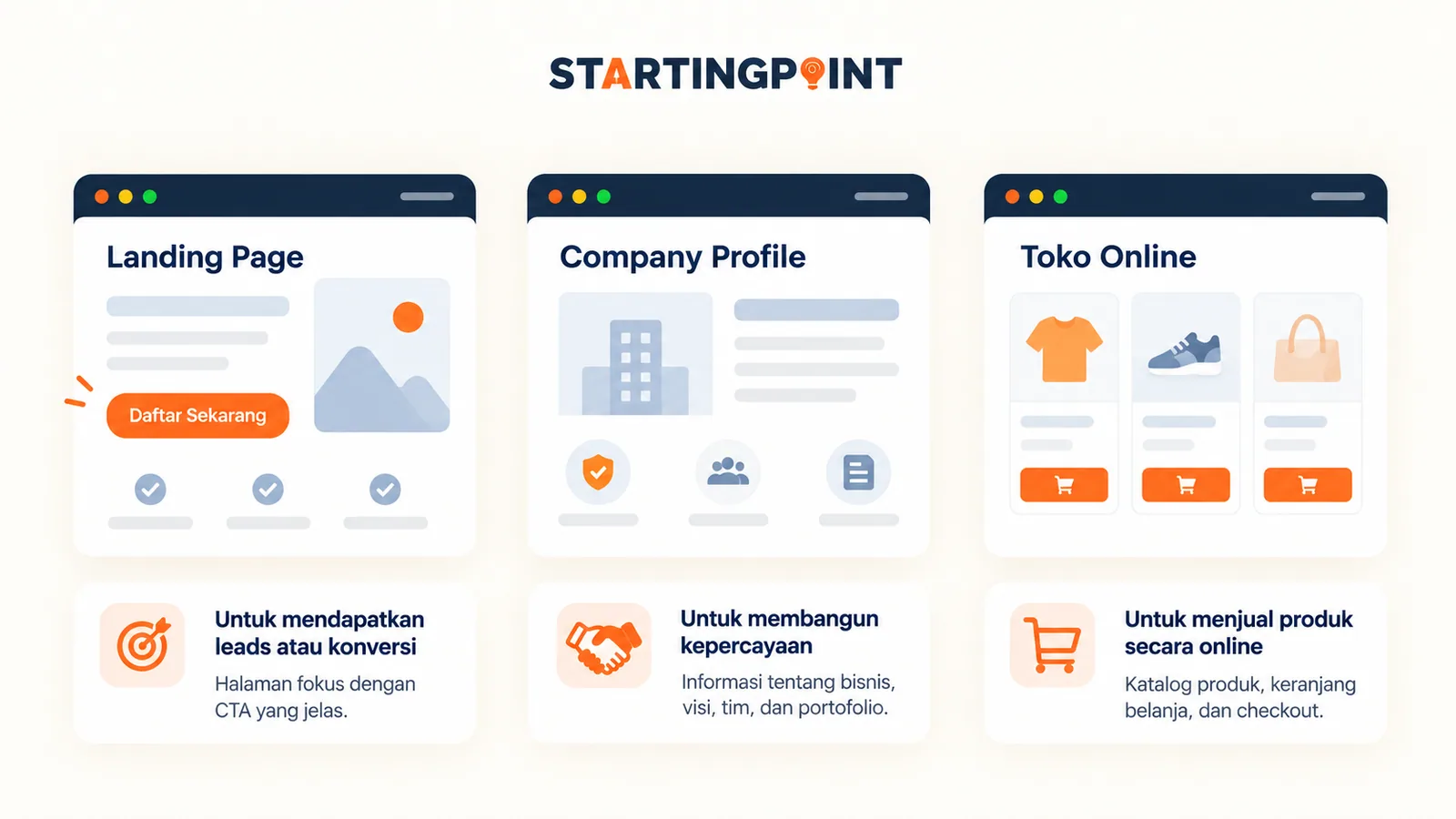
Before you ask about website design, there's a more decisive question: what should visitors do after opening your website? If the answer is “contact sales,” “get to know the company,” or “pay for an order,” the type of website you need may differ.
The three most common formats are the landing page, the company profile, and the online store. None is automatically better. The best choice is the one that creates the fewest obstacles between what customers need and the next action.
Landing page: one message, one primary action
A landing page is usually built to guide visitors toward one specific goal—requesting a demo, booking a consultation, or ordering a promotional product, for example. The page focuses on a single offer rather than showing everything about the company.
Example: a catering business launches a meeting package. The landing page shows the package options, minimum portions, sample menus, delivery area, relevant testimonials, and a WhatsApp button to request a quote.
A landing page works well when you're running an ad campaign, have one main service, or want to test market response. The downside: a single page can be too narrow for a business with many services, a team, a portfolio, and company information.
Company profile: answering questions about credibility
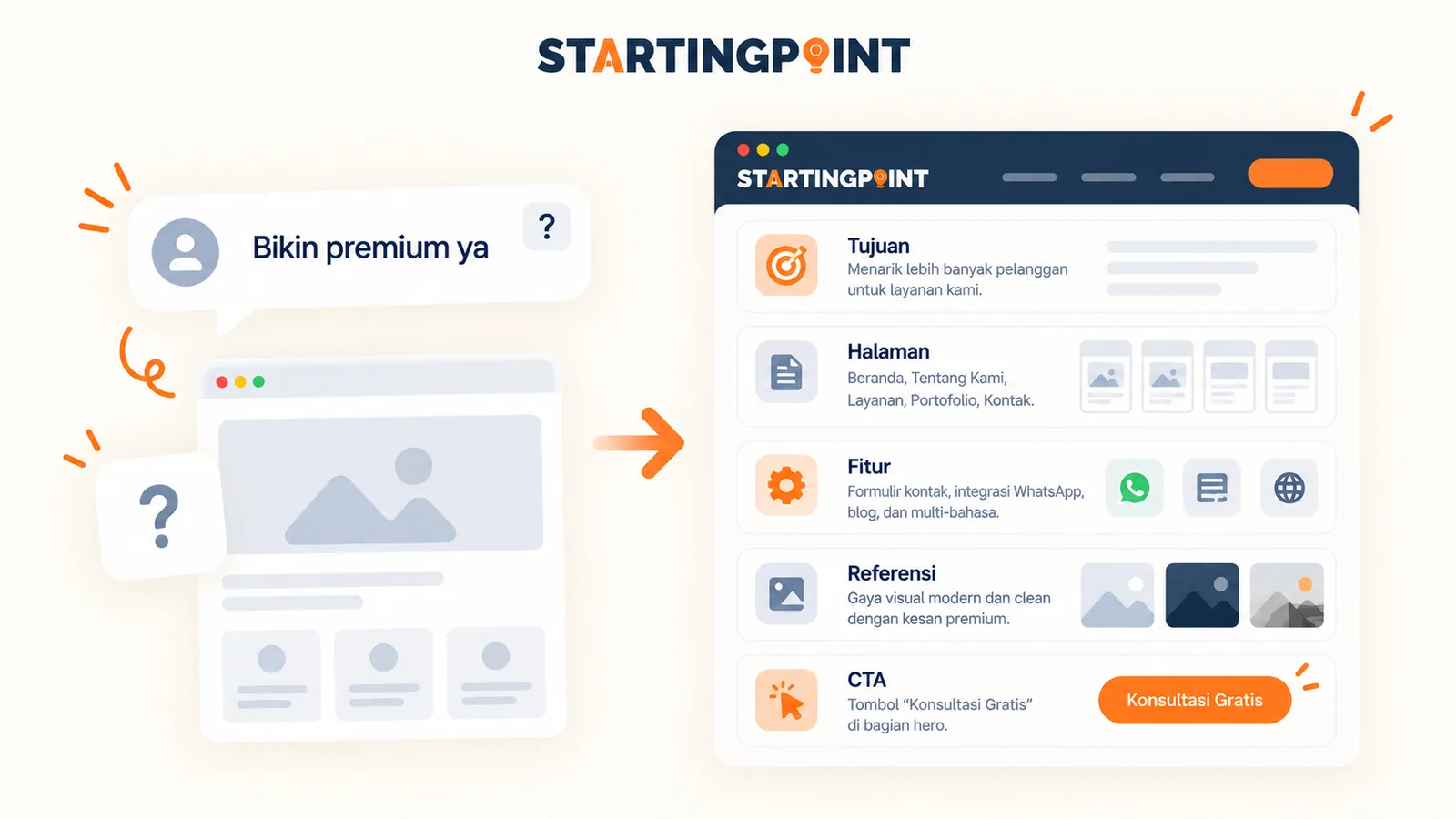
A company profile website helps people understand who you are, what services you offer, who they're for, and how to reach the team. A structure that often works: Home, About Us, Services, Portfolio, FAQ, and Contact.
Example: an interior contractor targeting office projects needs to show examples of its work, the consultation flow, its service area, and contact details. Prospective clients probably aren't ready to buy immediately; they want to assess the fit first.
The downside: if the website only contains company history and jargon with no clear action, visitors may leave without understanding how to start working with you.
Online store: helping customers choose and complete a purchase
An online store suits businesses where the catalog, variations, prices, order quantities, and transaction status are an important part of operations. Typical features include product pages, a cart, checkout, order management, and payment options.
Example: a home goods brand with dozens of SKUs and regular shipping is better served by a structured catalog and checkout than by processing every order through manual chat.
An online store doesn't always have to be the first step. If your products are custom and every order requires negotiation, a catalog with a quote request button can be more efficient.
A quick comparison table
| Question | Landing page | Company profile | Online store |
|---|---|---|---|
| Primary goal | Conversion from a single offer | Credibility and information | Catalog and transactions |
| Expected visitor action | Click the CTA or fill out a form | Read and get in touch | Choose products and check out |
| Key content | Benefits, proof, FAQ, CTA | Services, portfolio, profile | Photos, variations, prices, shipping |
| Operational complexity | Low–medium | Low–medium | Medium–high |
| Maintenance needs | Campaign updates | Information updates | Catalog, stock, and order updates |
Five scenarios to help you choose
New barbershop: if the main goal is bookings, a simple page with services, prices, location, opening hours, and a booking button is enough.
Consulting firm: choose a company profile with expertise, publishable work samples, the consultation flow, and team profiles.
Accessory seller with many products: an online store is a better fit if customers can buy without one-on-one consultations.
Short course launch: a landing page can focus on learning outcomes, schedule, curriculum, price, and registration.
B2B manufacturer: a company profile plus a catalog and a request-a-quote button is more relevant than direct checkout when each order has different specifications and pricing.
Can you combine all three?
Yes. A company website can have landing pages for specific campaigns and a catalog that grows into an online store. But don't pay for complex features just because you might need them someday. Choose the minimum version that solves today's problem, then plan your expansion.
Use the website brief checklist to translate your choice into clear features. If you're considering an online store, also read your own online store vs a marketplace.
Conclusion
Choose a landing page for one focused conversion, a company profile to introduce your business and build trust, and an online store to make transactions and catalog operations easier. Startingpoint offers custom website and e-commerce development; discuss your customer flow through our official website before choosing a package.