
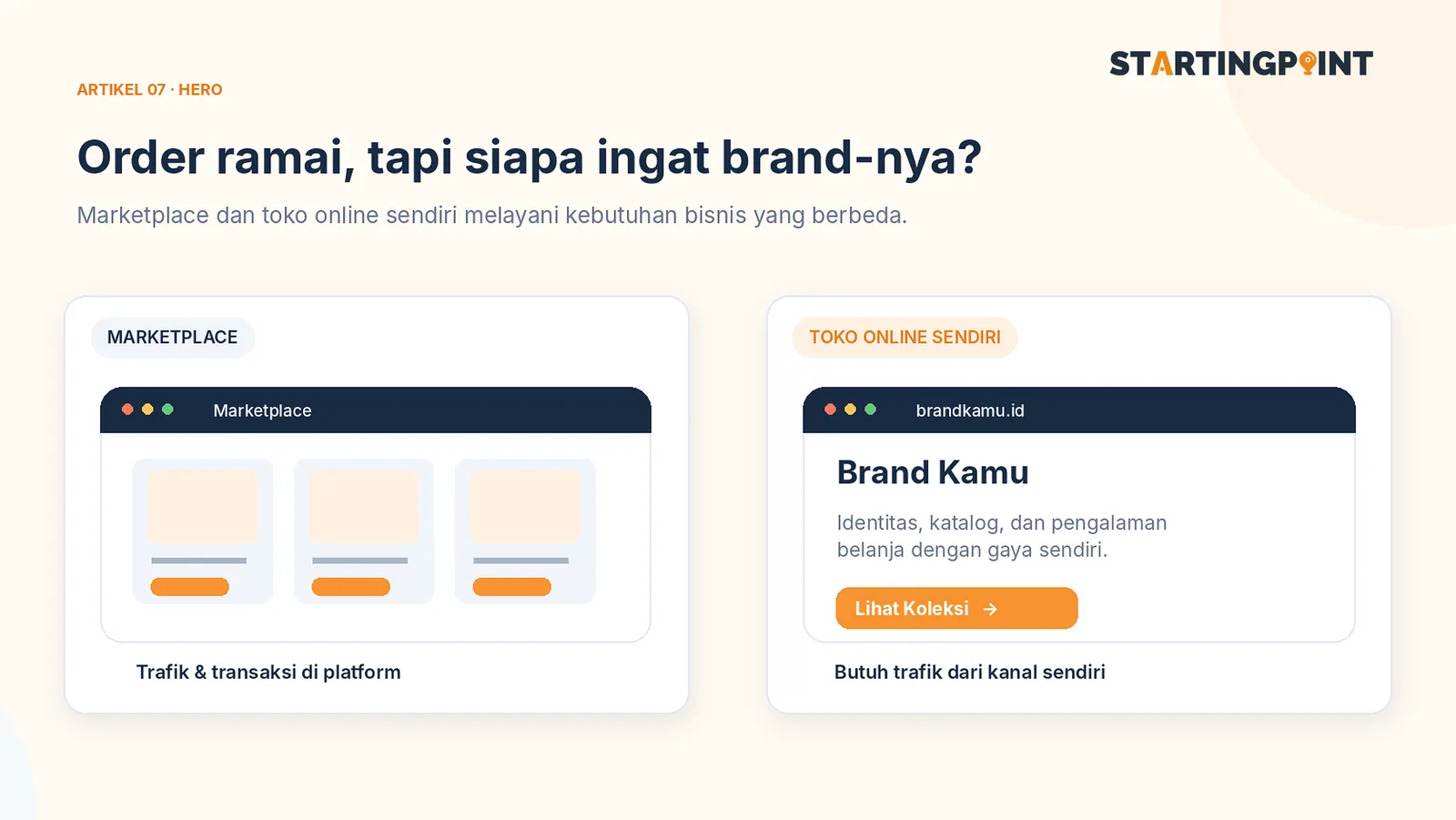
Marketplaces help stores meet shoppers who are already used to searching for and comparing products. An online store on your own domain, meanwhile, gives you more room to shape the shopping experience around your brand identity and operational needs.
The question isn't always “which one should I choose?” but rather when will having your own online store solve a problem the marketplace hasn't? The best answer depends on where your traffic comes from, the type of products you sell, and your team's ability to manage orders.
The marketplace's strength: demand is already gathered
On a marketplace, people arrive with the intent to shop. They're used to filtering by price, reading reviews, and comparing products. That's useful for a new brand without its own audience yet. Payment, promotion, and shipping infrastructure is also often available in systems consumers already know.
The challenge is direct competition with other sellers and dependence on platform rules that can change. Selling costs should be assessed according to the category, program, and terms of the marketplace you use—not assumed to be a fixed percentage for every store.
The strength of your own online store: control over the customer journey
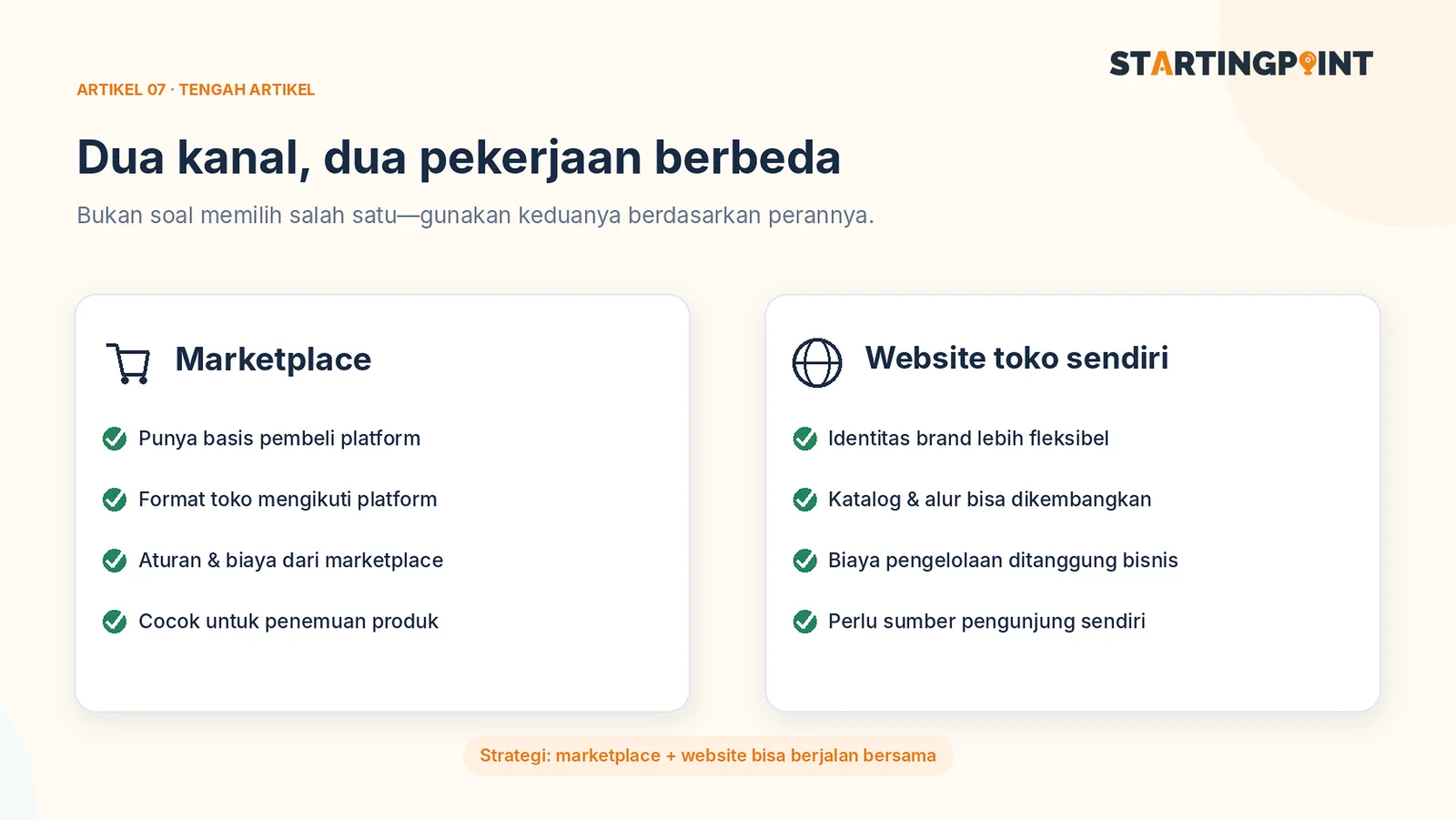
With your own website, you can decide the catalog structure, how product value is introduced, how bundles are displayed, educational content, and the checkout flow. Customers can also visit a consistent brand address on packaging, Instagram content, or business cards.
But there's an important consequence: a website doesn't bring traffic on its own. You still need to invite visitors from social media, Google search, email with consent, communities, or ad campaigns. You also need to plan customer service, transaction policies, and data management in line with applicable obligations.
Comparisons worth paying attention to
| Factor | Marketplace | Your own online store website |
|---|---|---|
| Product discovery | Assisted by the platform's internal search | Requires your own traffic strategy |
| Brand identity | Limited by the platform's display constraints | Freer to customize |
| Checkout flow | Determined by the platform | Can be designed to fit your needs |
| Costs | Fees and programs follow platform policy | Development, infrastructure, payments, operations |
| Customer management | Limited by the platform's access and rules | Requires your own data system and privacy policy |
| Dependence | On marketplace policy | On the vendor, infrastructure, and integrations you choose |
No option is completely free of cost or risk. Even a custom online store still relies on domain, infrastructure, and sometimes payment gateway providers.
Three signs you're starting to need an online store website
First: customers recognize your brand, not just the cheapest product. If people search for your brand repeatedly, you can offer a fuller, more consistent shopping experience through your own domain.
Second: your catalog needs explanations that don't fit on a marketplace. Technical products, custom packages, bundles, or B2B purchases often need specification tables, sizing guides, and quote request forms.
Third: you want to run ongoing marketing channels. Educational blogs, product guides, and category pages can become entry points from Google. But all of that requires investment in content and measurement—not just building a website and waiting for buyers to show up.
A safer, step-by-step strategy
Stage 1: validate your product on channels you already understand. Learn from customer questions, best-selling products, returns, and checkout friction.
Stage 2: build a brand information hub. Start with a domain and pages that answer the main questions: catalog, policies, contact, and product story. If every order still needs a conversation, a WhatsApp button may be enough.
Stage 3: enable self-service transactions once the flow is clear. A cart, payments, stock, and order management make sense when volume and business rules support them.
Stage 4: run the channels side by side. The marketplace helps you reach product searchers, while the website becomes the brand's reference point. Make sure cross-channel promotions comply with each platform's policies.
What should you prepare before building an online store?
Write down how many active SKUs you have, how shipping is calculated, payment methods, return rules, stock tracking, and who processes orders. If those aren't clear, even advanced features won't automatically fix your workflows.
Read the online store and payment gateway feature checklist to assess your transaction needs. If you need help defining the development scope, Startingpoint offers custom e-commerce services that can be discussed around your business model.
Conclusion
Marketplaces and your own website can complement each other. Build the website when there's a real operational or brand reason—not because you feel every business must have its own checkout from day one.